There are some garden projects you plan.
And then there are the ones that secretly become an obsession.
Saffron definitely falls into the second category.
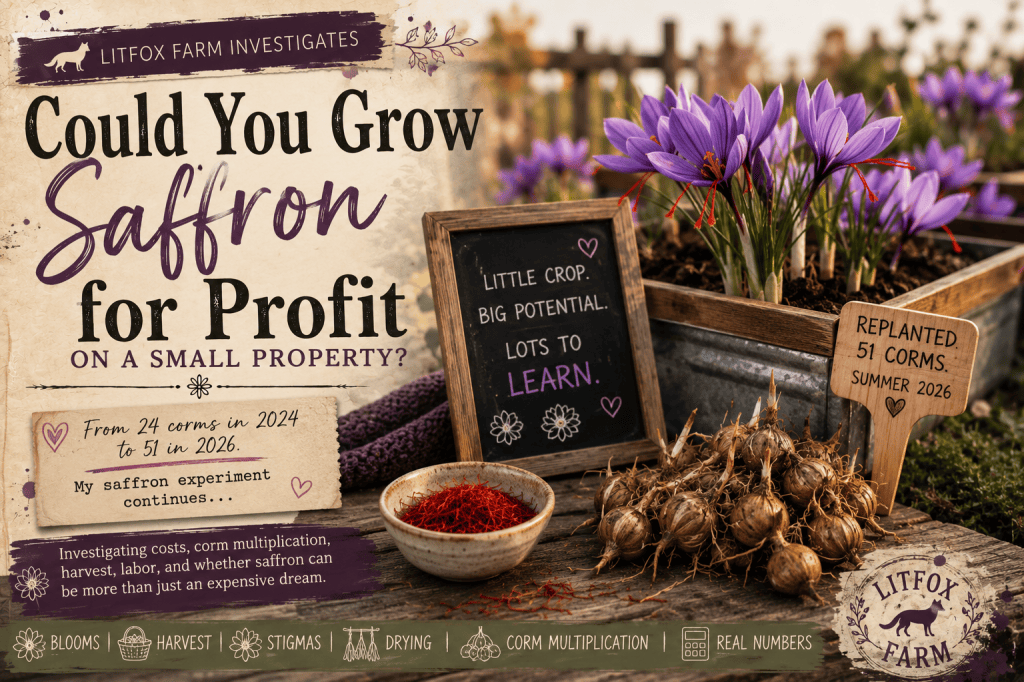
A few days ago, I replanted my saffron corms into a new waist-high raised bed.
Not because the old bed wasn’t working.
Because my back has officially started negotiating with me, and I figured if I’m hoping to grow this crop for years to come, I might as well make harvesting and dividing corms a little easier on Future Lindsay.
As I spread the corms across the bed, I couldn’t help but smile.
Back in 2024, I planted 24 tiny corms.
This summer, when I lifted them, I counted 51.
No, I didn’t suddenly become a commercial saffron grower.
No, I’m not claiming that’s what everyone should expect.
But seeing those extra corms sitting in the wheelbarrow made me stop and think.
“Huh… maybe there’s something here.”
Not a get-rich-quick scheme.
Not the next big agricultural revolution.
Just… something worth paying attention to.
So naturally, I started asking myself the question I seem to ask about everything these days:
Could saffron actually become a worthwhile crop for a tiny farmstead?
The Internet Makes Saffron Sound Like a Lottery Ticket
If you’ve ever searched for saffron online, you’ve probably seen the headline.
“The World’s Most Expensive Spice.”
It’s technically true.
And it’s also one of those facts that’s just misleading enough to send people down the wrong path.
The price sounds incredible because saffron is sold in tiny amounts.
Nobody is buying a five-pound bag of saffron for Tuesday night’s pasta.
You’re talking about delicate threads harvested by hand from thousands of flowers.
High price doesn’t automatically mean high profit.
That’s an important distinction.
Because while saffron may sell for impressive prices by weight, the journey from flower to spice is surprisingly labor intensive.
Three Little Threads
Every saffron flower produces exactly three red stigmas.
Those three tiny threads are the saffron.
That’s it.
No shortcuts.
No machines.
Every flower is picked by hand.
Every stigma is removed by hand.
Then everything has to be dried correctly.
Suddenly the high price starts making a little more sense.
When people say saffron is expensive…
It’s because somebody earned it.
The Part That Fascinated Me Wasn’t the Spice
Honestly?
It was the corms.
When I first planted saffron in 2024, I wasn’t thinking much beyond…
“Wouldn’t it be fun to grow my own saffron?”
I certainly wasn’t sketching business plans.
But when I lifted those original 24 corms and counted 51 healthy replacements…
My brain shifted.
Not toward spice.
Toward multiplication.
Because here’s the interesting thing about saffron.
If conditions are right, healthy corms can multiply over time.
Not overnight.
Not magically.
Not on a perfectly predictable schedule.
But steadily enough that I started wondering…
Could a small planting slowly become a larger one?
Could today’s little experiment eventually become several beds?
Could one nursery bed quietly support expansion for years?
Now we’re speaking my language.
My Goal Isn’t More Spice…
It’s Better Systems
One thing I learned this year?
Growing saffron and harvesting saffron are two different skills.
I successfully grew the corms.
Harvesting every bloom at exactly the right moment…
Let’s just say I have room to improve.
So this year’s goal isn’t to maximize income.
It’s to become a better saffron grower.
The new waist-high bed should make harvesting, dividing, and maintaining the planting much easier.
Sometimes the best investment isn’t buying more plants.
It’s making it easier to care for the ones you already have.
Then I Started Daydreaming
This is where things usually get dangerous.
Because once I started thinking about 51 corms…
I started wondering what happens after that.
Not next year.
Five years from now.
Ten years from now.
Could one bed become two?
Could a nursery bed eventually produce healthy corms for expansion?
Would there ever be enough to share with other gardeners?
Could I eventually sell corms?
Or would every extra one simply go back into expanding the planting?
I genuinely don’t know.
And that’s exactly why I’m writing this investigation instead of a how-to guide.
The Math Is More Complicated Than It Looks
The internet loves simple equations.
High-value spice.
×
Lots of flowers.
=
Profit.
Reality, as usual, refuses to cooperate.
Corms don’t all multiply equally.
Some flowers never bloom.
Harvest timing matters.
Drying matters.
Storage matters.
Labor definitely matters.
And while it’s fun to calculate theoretical retail values…
Those numbers don’t automatically become money in the bank.
The difference between revenue and profit is where real businesses live.
Then There’s the Question Nobody Talks About
What if the spice isn’t the most interesting product?
I’ve caught myself wondering whether the long-term opportunity for a tiny grower might actually be healthy corms.
Please notice I said wondering.
Not recommending.
Not predicting.
Just wondering.
People who want to grow saffron need corms.
Healthy, correctly identified corms.
And if a grower spends years carefully expanding a healthy planting…
Could that eventually become part of the business model?
Maybe.
But that’s a question for Future Lindsay.
Present Lindsay is still figuring out how not to miss flowers during harvest.
There Are Some Adult Conversations We Should Have
Before anybody starts packaging saffron in cute little jars…
Food products come with responsibilities.
Depending on where you live, labeling requirements, food regulations, cottage food laws, and licensing may apply.
The same goes for selling planting stock.
Plant health matters.
Quality matters.
Local regulations matter.
I’m intentionally taking the slow road here.
I’d much rather learn the rules now than apologize for ignoring them later.
Who Might Enjoy Growing Saffron?
I think saffron could be a wonderful fit for someone who:
- Enjoys unusual crops
- Likes long-term projects
- Has well-drained soil or raised beds
- Doesn’t mind careful hand harvesting
- Thinks in years instead of weeks
- Gets excited about watching things slowly multiply
Who Should Probably Skip It?
Saffron probably isn’t your crop if:
- You need quick cash flow.
- You dislike repetitive hand work.
- Your garden stays wet all winter.
- You’re hoping one raised bed replaces your salary.
- You lose interest when projects take several years to mature.
Hidden Headaches
A few stood out during my research—and now my own experience.
- Startup corms can be expensive.
- Harvest season is short.
- Every flower is harvested by hand.
- Timing matters.
- Expansion takes patience.
- The internet wildly oversimplifies saffron economics.
Most importantly…
The world’s most expensive spice still has to find a customer.
The LitFox Scorecard
Startup Cost: ⭐⭐⭐☆☆
Small Property Friendly: ⭐⭐⭐⭐⭐
Expansion Potential: ⭐⭐⭐⭐⭐
Patience Required: ⭐⭐⭐⭐⭐
Storage Simplicity: ⭐⭐⭐⭐☆
Labor During Harvest: ⭐⭐⭐⭐☆
Internet Hype Risk: ⭐⭐⭐⭐⭐
My Curiosity Level: ⭐⭐⭐⭐⭐
So… Could You Grow Saffron for Profit on a Small Property?
Maybe.
But I don’t think that’s the first question anymore.
After watching 24 corms become 51, I think the better question is:
Could you patiently build something meaningful over time?
That’s a much more interesting experiment.
This year, those 51 corms are settling into their new waist-high bed.
My goal isn’t to make money from them.
My goal is to become better at growing them.
To pay closer attention.
To improve my harvest.
To learn what this little crop wants to teach me.
Maybe five years from now, I’ll look back and laugh at how small this planting was.
Or maybe I’ll decide saffron is happiest staying exactly what it is today—a fascinating little corner of the garden.
Either outcome feels worthwhile.
Because one of the biggest lessons LitFox Farm keeps teaching me is this:
The best opportunities usually don’t arrive all at once.
They quietly multiply underground while you’re busy learning how to care for them.
And honestly…
That feels like a pretty good metaphor for building a life, too.
🌱 Want to Follow the Saffron Experiment?
This saffron bed is still very much an experiment.
Over the next few years, I’ll be documenting what happens… from bloom timing and harvest to corm multiplication, bed expansion, and whether saffron truly earns a permanent place in the LitFox Farm ecosystem.
If enough readers are interested, I’ll combine the research, the real-world results, and everything I learn into a practical Saffron Quick-Start Guide for anyone who wants to run their own experiment.
Interested? Join the Saffron Experiment and I’ll keep you posted.
 LitFox Farm