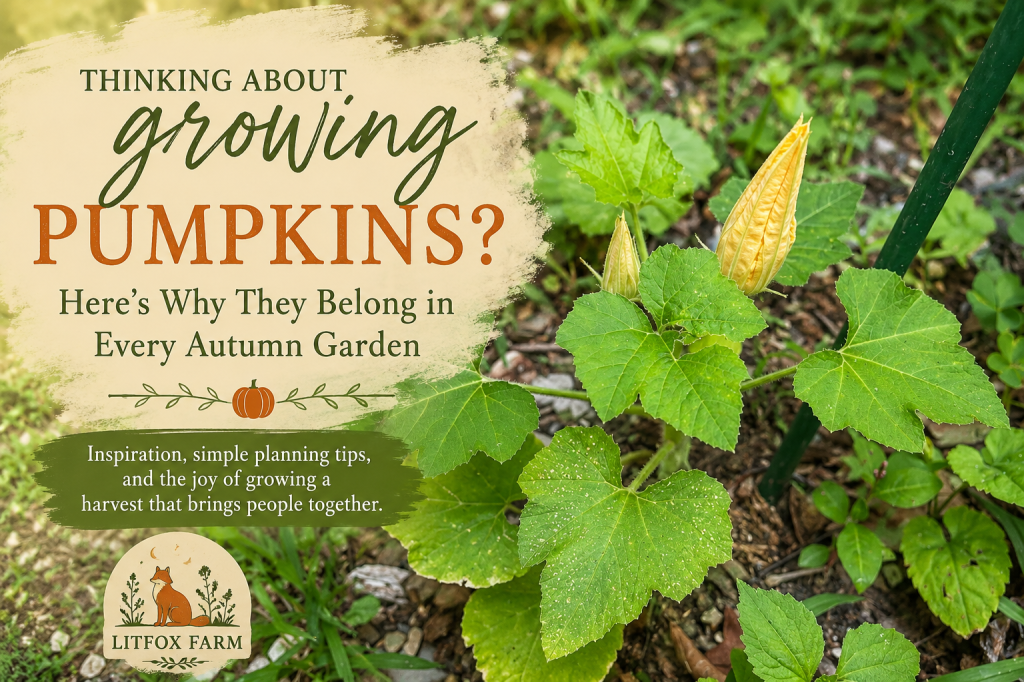
There comes a moment every summer when the garden begins to whisper that the seasons are changing.
It doesn’t happen all at once. The calendar may still insist it’s summer, and the afternoons can still be hot enough to send you searching for shade. But if you spend enough time outside, you’ll notice the little signs.
Tomatoes begin blushing red on the vine.
Sunflowers stretch confidently toward the sky.
The first goldenrod starts appearing along country roads.
Even the mornings feel different. Just for a few minutes before the sun climbs higher, there’s the faintest hint of coolness in the air—a quiet reminder that autumn is already making its way toward us.
And somewhere beneath a tangle of sprawling green vines, something magical is happening.
Pumpkins are growing.
They don’t announce themselves with bright blooms like zinnias or towering stalks like corn. Instead, they quietly swell beneath broad leaves, almost hidden until one day you lift a vine and realize there’s a pumpkin sitting there, patiently becoming exactly what it was meant to be.
That’s one of the things I love most about pumpkins.
They teach us to think months ahead.
Long before porch decorations appear in stores, before apple cider fills mugs, before sweaters come out of storage, pumpkin growers have already been tending vines, watching blossoms open, welcoming bees, watering through dry spells, and trusting that nature knows what she’s doing.
Growing pumpkins asks us to slow down.
To prepare.
To wait.
To believe that today’s small efforts become tomorrow’s harvest.
If you’ve ever dreamed about having your own pumpkin patch—even if it’s only a few vines tucked into the corner of your yard—mid-summer is actually the perfect time to start learning. Not because you’ll be planting tomorrow, but because watching the season unfold helps you understand what pumpkins need and how they fit into the rhythm of the year.
This isn’t meant to be a complete growing guide. Think of it more like a conversation while we wander through the garden together, imagining what next year’s harvest could become.
Why Pumpkins Are Such a Wonderful Beginner Crop
Every gardener remembers growing something for the first time.
Maybe it was a tomato plant on an apartment balcony.
A handful of beans climbing a fence.
A sunflower that somehow became taller than everyone expected.
For many people, pumpkins become one of those unforgettable first adventures.
Part of the reason is simply how approachable they are.
Pumpkin seeds are easy to find. Every spring, garden centers, seed catalogs, and local hardware stores seem to carry at least a handful of varieties. You don’t have to search for rare seed suppliers or invest a fortune before getting started.
They’re also surprisingly affordable.
A single packet of seeds can grow several healthy plants, each capable of producing multiple pumpkins depending on the variety and growing conditions.
That’s a pretty wonderful return on a small investment.
Pumpkins also tend to be forgiving teachers.
Will every vine produce perfect fruit? Probably not.
Will insects visit?
Will weather throw you a few surprises?
Almost certainly.
But that’s part of gardening.
Pumpkins introduce beginners to these lessons in a way that feels exciting rather than discouraging.
They’re also one of the few crops that seem to delight every generation.
Children love watching tiny green pumpkins appear where flowers once bloomed.
Adults find themselves checking the vines almost daily.
Neighbors stop to ask how they’re growing.
Before long, the pumpkin patch becomes something people naturally gather around.
Perhaps most importantly, pumpkins teach patience.
You cannot hurry a pumpkin.
No amount of wishing will make it ready before its time.
Instead, pumpkins invite us to embrace a slower rhythm—a lesson that’s becoming increasingly valuable in a world that often expects instant results.
Growing pumpkins isn’t just about producing food or decorations.
It’s about learning to notice the seasons.
It’s about understanding that gardening isn’t measured only by what we harvest but also by the experiences we collect along the way.
In many ways, pumpkins become less of a crop and more of an annual tradition.
A Walk Through the Pumpkin Patch
If you’ve never wandered through a pumpkin patch in late July, I hope you’ll make time to do it this year.
Most people visit pumpkin farms in October.
Few realize how alive they are in midsummer.
The vines seem to have a mind of their own.
They stretch across the ground, curling around themselves, weaving between grasses, and slowly claiming every bit of open space they can find.
Their broad leaves create little islands of cool shade beneath the summer sun.
Bright yellow blossoms seem to appear everywhere at once.
Some bloom for only a short while before fading, having quietly completed their purpose.
Listen closely and you’ll hear the steady hum of bees.
They move from flower to flower with remarkable focus, carrying pollen that makes the next generation of pumpkins possible.
Without them, there would be no harvest.
Beneath those blossoms, tiny pumpkins begin to form.
Some are no larger than a marble.
Others already resemble miniature versions of the pumpkins they’ll eventually become.
Each one represents possibility.
Walking through a pumpkin patch reminds us that gardens are never still.
Even when nothing seems to be happening, life is unfolding beneath the leaves.
This fall, if you visit a local pumpkin farm, pause for a moment before heading straight to the biggest pumpkins.
Look at the vines.
Notice the leaves.
Watch the bees.
See if you can imagine what the field looked like just a few months earlier.
There’s something deeply comforting about realizing every pumpkin began as a single blossom and a little patience.
Choosing the Right Pumpkin
One of the happiest surprises for new gardeners is discovering that “pumpkin” isn’t just one thing.
There are dozens—really hundreds—of varieties, each with its own personality.
Some are perfect for carving.
Others shine in the kitchen.
Some exist simply because they’re beautiful.
Jack-o’-lantern pumpkins are probably the ones most people picture first. They’re the classic orange pumpkins that become smiling faces on front porches each October.
Pie pumpkins are smaller and sweeter. While they may not look as dramatic, they’re prized for baking into pies, breads, soups, and other autumn favorites.
White pumpkins bring a completely different feeling to the garden. Their creamy color pairs beautifully with fall flowers and natural decorations, creating a softer harvest display.
Mini pumpkins might fit in the palm of your hand, but they’re packed with charm. Scatter them across a table, tuck them into window boxes, or let children decorate with them.
Decorative gourds are wonderfully quirky. Twisted, striped, bumpy, colorful—each one seems to have its own personality.
Then there are heirloom varieties.
These pumpkins often carry fascinating histories and unique shapes, colors, and textures that remind us how diverse gardening can be. Some are blue-gray, some are deeply ribbed, and others seem almost too beautiful to harvest.
Choosing a pumpkin variety isn’t just about size.
It’s about imagining the traditions you’d like to create.
Do you dream of homemade pie?
Family carving nights?
Autumn porch displays?
A harvest table filled with every color imaginable?
The pumpkins you grow can become part of those memories.
Planning for Next Year
One of the most enjoyable parts of gardening happens long before the first seed goes into the ground.
It’s the dreaming.
Winter and early spring often become seasons of planning.
Where might the pumpkin patch go?
How much sunshine does that corner of the yard receive?
Will the vines have enough room to wander?
Pumpkins appreciate generous space.
They’re enthusiastic growers, and that’s part of their charm.
Healthy soil is another gift we can prepare ahead of time.
Good gardens rarely happen by accident.
Over time, adding compost, encouraging healthy soil life, and caring for the land creates a stronger foundation for every crop that follows.
Pollinators deserve a place in the plan as well.
A garden buzzing with bees, butterflies, and other beneficial insects is a joyful sight, and pumpkins depend on many of those visitors.
Thinking about water is equally worthwhile.
Summer weather has a way of surprising us, and having a watering plan before it’s needed often makes gardening feel less stressful.
Finally, there’s harvest.
Not just harvesting pumpkins, but imagining what comes afterward.
Where will they cure?
How will they be displayed?
Will neighbors receive one?
Will seeds be saved?
Planning ahead transforms gardening from a series of chores into something much more intentional.
Each decision becomes part of a story that’s still unfolding.
Harvest Season
There comes a day when you realize the pumpkin has stopped growing.
Instead of becoming larger, it begins becoming richer.
Its color deepens.
The rind hardens.
The stem slowly changes, hinting that harvest isn’t far away.
It’s one of my favorite transitions in the entire gardening year.
Harvest isn’t simply about picking pumpkins.
It’s about recognizing the season you’ve been working toward all along.
Carefully cutting the pumpkin while leaving a portion of the stem attached helps prepare it for the weeks ahead.
Many gardeners also allow pumpkins to cure for a short time, helping them store longer and develop even better color.
Then comes the fun part.
Pumpkins appear on porches beside pots of mums.
They become centerpieces for autumn tables.
Some head into the kitchen.
Others become decorations that welcome friends and family throughout the season.
Extra pumpkins often find their way to neighbors, coworkers, teachers, or relatives.
There’s something wonderfully old-fashioned about sharing part of the harvest.
Even after the pumpkins have been enjoyed, the season isn’t quite finished.
Seeds can be cleaned and saved for future gardens.
Others become roasted snacks.
Eventually, the vines and leftover plant material return to the compost pile, beginning the cycle once again.
Gardening has a beautiful way of reminding us that endings are often beginnings in disguise.
More Than Just Halloween
It’s easy to think of pumpkins as decorations.
After all, that’s how many of us first experienced them.
But pumpkins become much more meaningful once you’ve grown them yourself.
A homemade pumpkin soup on a chilly evening somehow tastes even better when the pumpkin came from your own garden.
Fresh pumpkin pie carries an entirely different story when you’ve watched that fruit grow from blossom to harvest.
Roasted pumpkin seeds become a satisfying reminder that very little needs to go to waste.
Even empty shells can become wildlife food, compost, or simply nourish next year’s garden.
Pumpkins also create moments.
Family photographs.
Children proudly carrying tiny pumpkins they’ve grown themselves.
Friends gathering for cider around a porch filled with autumn color.
Visits to local farm stands.
Community harvest festivals.
These are the memories that tend to stay with us.
For some families, pumpkin growing slowly grows into something larger.
A roadside stand with extra pumpkins.
Seasonal decorating bundles.
A small patch that welcomes neighbors each fall.
For others, one or two vines provide everything they need.
Both paths are equally worthwhile.
A meaningful harvest isn’t measured by acreage.
It’s measured by the joy it brings.
A Gentle Invitation
Sometimes we convince ourselves that we need to know everything before we begin.
We read every guide.
Watch every video.
Compare every variety.
Meanwhile, another growing season quietly passes by.
Gardens don’t ask us to know everything.
They simply ask us to begin.
Many beautiful homesteads started with one raised bed.
One tomato plant.
One herb tucked beside the back door.
Or one little patch of pumpkins.
Each season teaches something new.
One year you’ll learn about pollinators.
Another year you’ll discover the importance of healthy soil.
Another season might simply remind you how peaceful it feels to spend an evening walking among the vines.
There is no finish line.
Only another season waiting to begin.
If growing pumpkins has been sitting quietly on your someday list, perhaps this is the year to start imagining where those vines might grow next spring.
Sometimes that’s all a dream needs—a little room to take root.
In summary…
Pumpkins have a remarkable way of reminding us that some of life’s best rewards cannot be hurried.
They invite us to prepare long before anyone else is thinking about autumn.
They ask us to care consistently through hot summer days, to trust unseen growth beneath broad green leaves, and to celebrate when the harvest finally arrives.
Whether your dream is a front porch lined with homegrown pumpkins, a family tradition of carving pumpkins together each October, a roadside stand overflowing with autumn color, or a future pumpkin patch where neighborhood children make memories they’ll carry for years, every harvest begins the same way.
With a single seed.
Planted months before anyone else is thinking about fall.
And perhaps that’s the real lesson pumpkins offer us.
The life we hope to enjoy tomorrow is often shaped by the quiet things we’re willing to nurture today.
Join the Waitlist: Growing Pumpkins for Pleasure & Profit
If today’s walk through the pumpkin patch has you dreaming about next year’s garden, I’d love to invite you to join the waitlist for our upcoming guide, Growing Pumpkins for Pleasure & Profit.
This future guide will take a deeper look at planning your first pumpkin patch—from choosing the right varieties and preparing healthy soil to seasonal care, harvesting, curing, and saving seeds for future seasons. We’ll also explore simple ways to share or sell extra pumpkins through farm stands or local markets, along with ideas for creating meaningful autumn traditions around your harvest.
Whether your goal is to grow a few pumpkins for your family or simply learn more about this timeless crop, we’d love to have you along for the journey.
Join the waitlist today, and you’ll be among the first to know when the guide is ready.
Until then, enjoy the season you’re in—and keep dreaming about the one that’s still to come.