I have a confession.
My roadside flower stand does not currently exist.
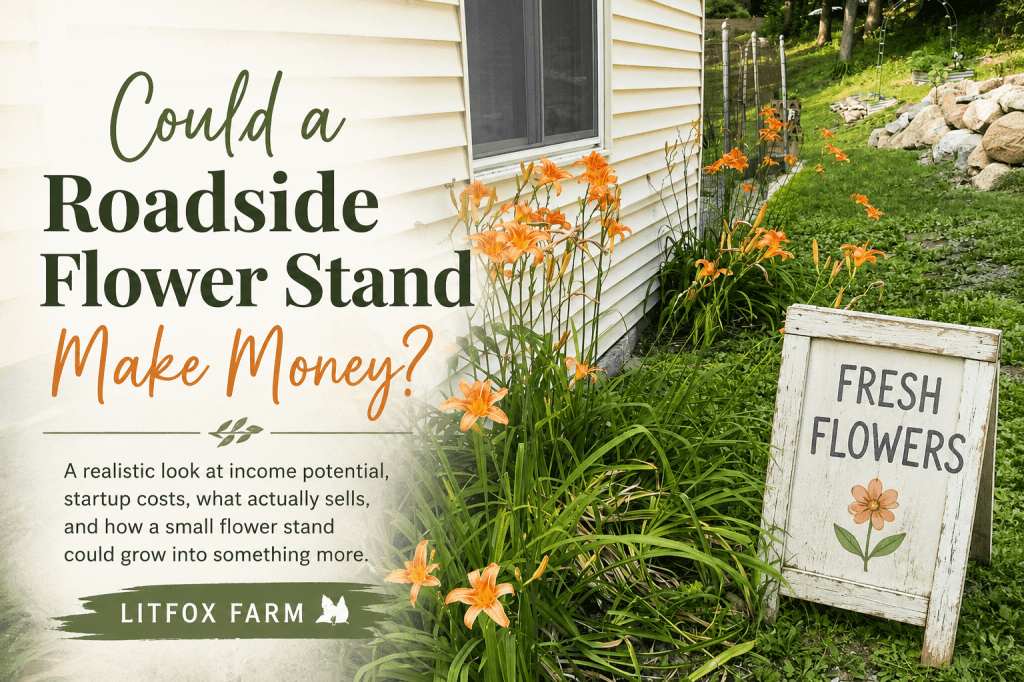
At the moment, it is mostly a suspiciously detailed daydream involving buckets of zinnias, dahlias, sunflowers, a cute little self-serve stand near the road, and me somehow becoming the kind of person who casually says things like, “I need to restock the bouquets.”
Which is how most of my ideas begin, if we’re being honest.
First, I plant six sunflowers.
Then I do math.
Then suddenly I’m mentally operating a small agricultural enterprise.
So naturally, I started wondering:
Could a roadside flower stand actually make money?
Not internet money.
Not “one woman made $100,000 selling flowers and therefore obviously you can too” money.
I mean real, ordinary-person money.
Could someone with a small property, a patch of decent sunlight, and a willingness to grow a slightly unreasonable number of flowers create a roadside stand that actually brings in meaningful income?
Let’s investigate.
First: What Do I Mean by a Roadside Flower Stand?
I’m not talking about opening a full florist shop.
I’m thinking something much smaller:
- A self-serve stand at the edge of your property
- Wrapped bouquets or mason jar arrangements
- A cash box, QR code, or digital payment option
- Limited hours or weekend-only sales
- Flowers grown primarily on your own property
- Maybe a few add-ons as the business grows
The simplest version might be a table with six bouquets and an honor box.
The more developed version could eventually include:
- Mixed bouquets
- Single-variety bunches
- Sunflower bunches
- Dahlia bouquets
- Dried flowers
- Herb bundles
- Seasonal wreaths
- Seed packets
- Plant starts
- Garlic
- Pumpkins
- Whatever else your particular little patch of earth is producing
That last part is important because I don’t think the most interesting question is whether flowers alone can make money.
I think the bigger question is whether a flower stand can become the front door to a tiny farm business.
The Very Basic Flower Stand Math
Let’s start small.
Suppose you sell bouquets for $15 each.
If you sell:
- 5 bouquets per week = $75
- 10 bouquets per week = $150
- 20 bouquets per week = $300
Now assume a 20-week selling season.
That gives us:
- 5 bouquets/week = $1,500 gross seasonal revenue
- 10 bouquets/week = $3,000 gross seasonal revenue
- 20 bouquets/week = $6,000 gross seasonal revenue
That is gross revenue, not profit.
We still have to account for things like:
- Seeds
- Tubers
- Corms
- Compost
- Fertilizer
- Irrigation
- Bouquet sleeves
- Rubber bands
- Jars or containers
- Signage
- Stand construction
- Payment processing
- Unsold flowers
- Your time
Still, this is where the idea starts getting interesting.
Because I am not looking at this and thinking:
Great. I shall immediately quit my job and become the Dahlia Baroness of Sussex County.
I’m thinking:
Wait. Could a patch of flowers pay for itself?
Could it pay for next year’s seeds?
Could it pay for a new raised bed?
Could it cover the cost of irrigation?
Could it fund a greenhouse?
Could it eventually become one of several small income streams coming from the same property?
That is a much more realistic—and, frankly, more useful—question.
What If the Stand Sold 10 Bouquets Per Week?
Let’s play with a middle-of-the-road example.
Imagine a small roadside stand selling:
10 bouquets per week at $15 each
That is:
$150 per week
Over 20 weeks:
$3,000 gross revenue
Now suppose your direct annual flower-stand expenses came to $1,200.
That would leave:
$1,800 before taxes and before assigning a value to your own labor.
Is $1,800 life-changing money?
Probably not.
But could $1,800 pay for:
- A substantial seed order?
- Irrigation improvements?
- A new growing bed?
- Part of a greenhouse?
- Fruit trees?
- A pressure canner?
- Backup water storage?
- Next year’s flower production?
Absolutely.
And this is where I think small-scale farm income gets underestimated.
Not every income stream needs to replace a salary.
Sometimes one little enterprise pays for the infrastructure that makes the next enterprise possible.
The Better Question Might Be: How Much Can You Sell Per Customer?
A $15 bouquet is one thing.
But what if someone stops and buys:
- One $15 bouquet
- One $6 herb bundle
- One $8 bag of garlic
- One $5 packet or bundle of dried flowers
Suddenly, that customer is worth $34 instead of $15.
This is why I keep coming back to the idea of the roadside stand as a platform rather than a single product.
Flowers get attention.
They are beautiful.
They are visible from the road.
They create the:
“Oh! What’s that?”
moment.
But once someone stops, the stand could eventually offer whatever makes sense for the property and season.
At LitFox Farm, I can imagine some combination of:
- Fresh bouquets
- Sunflower bunches
- Dahlias
- Zinnias
- Dried flowers
- Lavender
- Herbs
- Garlic
- Saffron-related products where legally appropriate
- Plant starts
- Seasonal zines
- Small handmade goods
Not all at once.
I am one woman, not a rural Target.
But over time? The possibilities start stacking.
A Roadside Flower Stand Has One Huge Advantage: Low Overhead
A traditional retail flower business may need commercial space, regular staffing, refrigeration, significant inventory, and consistent operating hours.
A tiny roadside stand can potentially start much leaner.
The smallest version might use:
- Flowers you already grow
- A basic table or stand
- Simple signage
- Bouquet sleeves
- A secure payment method
- Limited inventory
You could test demand before building the adorable permanent farm stand currently living rent-free in your Pinterest board.
That matters.
Because one of the easiest ways to turn a charming side business into an expensive regret is to build all the infrastructure before confirming that anyone wants to buy the thing.
A smarter progression might be:
Year 1: Occasional pop-up table
Year 2: Consistent weekend stand
Year 3: Small permanent self-serve structure
Year 4: Expanded seasonal products
Year 5: Congratulations, apparently we have accidentally built a tiny farm business.
That progression makes far more sense to me than spending thousands of dollars upfront because three people on Instagram said roadside stands are “passive income.”
Spoiler: This Is Not Passive Income
The stand may sell while you are doing something else.
The flowers do not grow themselves.
There is:
- Bed preparation
- Seeding
- Transplanting
- Watering
- Weeding
- Staking
- Pest management
- Harvesting
- Conditioning
- Arranging
- Wrapping
- Pricing
- Restocking
- Cleaning
- Tracking what sells
- Crying quietly when the weather behaves like weather
A self-serve stand can reduce the amount of time spent physically staffing a sales location.
That does not make the business passive.
It makes it asynchronous.
And I think that distinction matters.
Location Could Make or Break the Whole Thing
You can grow the prettiest dahlias in New Jersey, but if your stand is hidden on a road where six cars pass per day—and four of them are the same neighbor—you may have a problem.
A roadside stand benefits from:
- Safe pull-off space
- Good visibility
- Clear signage
- Enough traffic
- Easy payment
- Consistent availability
- Customers who can stop without feeling like they are trespassing
This is one reason I would test before investing heavily.
Put out a small number of bouquets.
Track:
- How many sell
- What days sell best
- What price points move
- Which flowers disappear first
- Whether people pay reliably
- Whether weather affects sales
- Whether customers return
The first season should be an experiment, not a coronation.
The Honor-System Question
Yes, theft is possible.
So is underpayment.
So is someone scanning your payment code, deciding they’ll “do it later,” and vanishing into the universe with your best bouquet.
That risk has to be considered.
But I would not automatically assume the answer is to build Fort Knox around twelve zinnias.
Instead, I’d test:
- Low inventory at first
- Clear pricing
- Multiple payment options
- A locked cash box
- Good visibility
- Strategic stand placement
- Restocking in small batches
If losses become meaningful, adjust.
Again: evidence before drama.
What Could Make a Small Flower Stand More Profitable?
My suspicion is that profitability improves when the grower gets better at five things.
1. Growing the Right Flowers
Not every flower makes a great cut flower.
A profitable stand needs flowers that offer some combination of:
- Strong stems
- Good vase life
- High productivity
- Repeat blooming
- Customer appeal
- Efficient harvesting
This is one reason flowers like zinnias and sunflowers keep showing up in small flower-farm conversations.
And yes, this is also me publicly justifying the zinnias and sunflowers I already planted.
Convenient.
2. Succession Planting
A beautiful stand for two weeks is lovely.
A stand with something to sell across a longer season is a business.
That means thinking about:
- Early season
- Midseason
- Late season
- Repeated sowings
- Bloom gaps
- Weather risk
The goal is not merely to grow flowers.
The goal is to have flowers when customers want to buy them.
3. Increasing Average Transaction Value
A customer stopping for one bouquet is good.
A customer stopping for a bouquet plus garlic plus herbs is better.
This is where a diversified micro-farm may have an advantage.
4. Building Repeat Customers
The dream is not constantly convincing new strangers that flowers exist.
The dream is someone thinking:
“I need something for my mother-in-law. I’ll stop at that little flower stand.”
That habit has value.
5. Tracking What Actually Sells
Not what you love.
Not what Pinterest loves.
Not what looked adorable in the seed catalog at 11:47 p.m. in February.
What actually sells.
If $12 sunflower bunches disappear and elaborate $25 mixed bouquets sit there wilting, the stand is telling you something.
Listen.
So… Could a Roadside Flower Stand Actually Make Money?
I think the answer is:
Yes—but probably not in the magical way the internet sometimes suggests.
A small roadside flower stand could potentially create:
- A few hundred dollars in experimental first-season sales
- A few thousand dollars in seasonal gross revenue
- A meaningful contribution toward garden or farm infrastructure
- A customer base for additional farm products
- A stepping stone into a larger cut-flower or micro-farm business
Could it replace a full-time salary?
That would require a very different scale, production system, market, and business model than the tiny self-serve stand I’m imagining here.
But could a modest flower patch become a small income-producing asset?
I think so.
And that is enough to make me curious.
The LitFox Farm Verdict
Startup cost: Low to moderate, depending on existing infrastructure
Time to first dollar: Potentially one growing season
Part-time friendly: Yes, with serious caveats during planting and harvest periods
Customer interaction: Low to moderate with a self-serve model
Physical demand: Moderate to high
Scalability: Moderate
Income potential: Modest at tiny scale, increasingly interesting as products and customer traffic expand
Biggest hidden headache: Producing consistent, saleable inventory instead of one glorious explosion of flowers followed by absolutely nothing
Internet hype risk: Medium
LitFox verdict: Worth experimenting with—especially if you already want to grow flowers anyway.
And that last part may be the deciding factor for me.
I am already building the flower patch.
I already want the zinnias.
I already want the dahlias.
I already planted the sunflowers.
So perhaps the first goal does not need to be:
Build a profitable flower business.
Maybe the first goal is simply:
Grow enough flowers to put six bouquets by the road and see what happens.
That feels like a very LitFox Farm kind of experiment.
And unfortunately for everyone around me, I am now doing math again.
Thinking about starting your own roadside flower stand? 🌻
I’m considering creating a practical, no-hype Quick-Start Guide covering startup costs, what to grow, pricing, stand setup, keeping bouquets fresh, and what it could realistically take to make your first sales.
Join the interest list and I’ll let you know if I publish it.


 LitFox Farm