Tag: LitFox Farm

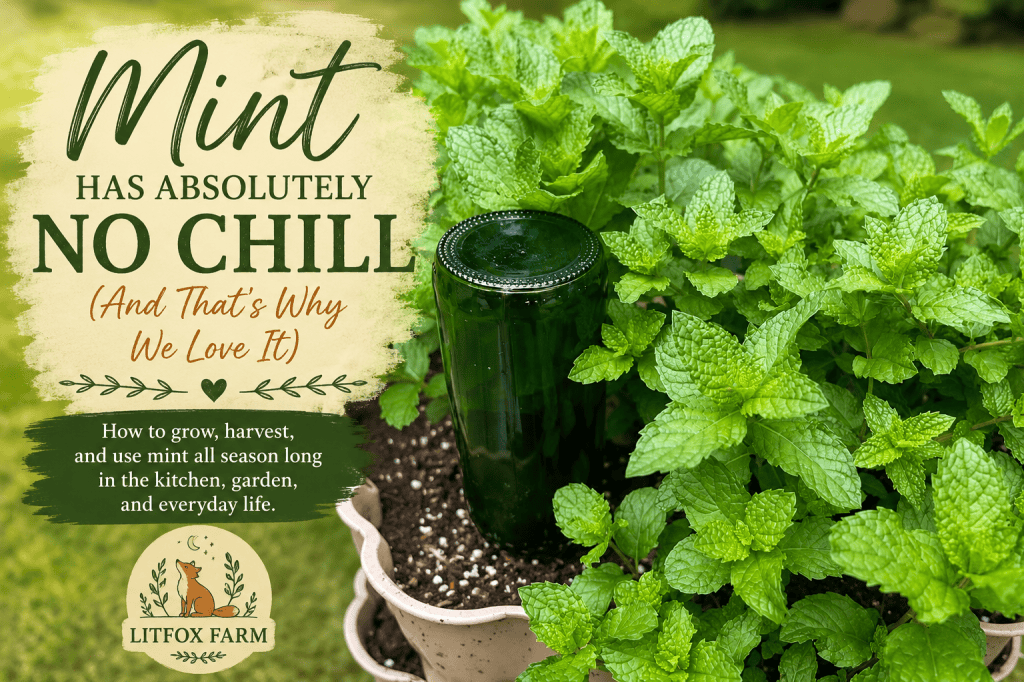
  • Mint Has Absolutely No Chill (And That’s Why We Love It)

    Mint Has Absolutely No Chill (And That’s Why We Love It)

    If herbs had personalities, mint would absolutely be the neighbor who shows up uninvited, brings snacks, rearranges your furniture, and somehow convinces everyone it was a great idea.

    Give mint a cozy little corner of the garden and it’ll politely thank you… before quietly plotting world domination.

    Every gardener has a mint story.

    “I planted one tiny plant.”

    “Now it’s… everywhere.”

    Honestly? I kind of respect the confidence.

    Mint has serious main-character energy, and despite its ambitious nature, it’s one of my favorite herbs to grow. It’s cheerful, forgiving, smells incredible, and asks for very little while giving back all season long.

    If you’ve ever thought about growing herbs but weren’t sure where to start, let me gently introduce you to the wonderfully overachieving world of mint.

    Why Everyone Should Grow Mint

    Some plants earn their place in the garden through beauty.

    Others earn it by feeding us.

    Mint somehow manages to do both while making the entire garden smell like a spa every time you brush past it.

    On warm September mornings, I’ll wander outside with a mug in one hand and absolutely no plan in the other. Somewhere along the way I’ll inevitably stop beside the mint, pinch off a few sprigs, rub a leaf between my fingers, and stand there for a minute breathing it in.

    It smells like summer decided to linger just a little longer.

    The bees seem to agree.

    If you let your mint flower, don’t be surprised if it becomes one of the busiest little restaurants in your garden. Bumblebees, honeybees, butterflies—they all seem to know exactly where the mint is.

    And then there’s the tea.

    Fresh mint tea.

    Iced mint tea.

    Mint tucked into lemonade.

    Mint floating in a pitcher of ice water because suddenly you’re the kind of person who casually has fresh herbs on hand.

    It’s a nice feeling.

    Perhaps the best part is that mint doesn’t ask for perfection.

    It isn’t one of those plants that acts personally offended because you forgot to admire it for three days.

    It’s remarkably forgiving, making it a wonderful herb for beginners or anyone who’s still figuring this whole gardening thing out.

    Better yet, once it’s happy, it tends to come back year after year.

    Like that friend who always knows where the good snacks are.

    The One Rule of Mint

    There is, however, one tiny conversation we need to have.

    Mint likes to spread.

    Actually…

    “Likes” might be underselling things.

    Mint sees empty garden space the way toddlers see puddles.

    As an opportunity.

    That doesn’t mean it’s difficult.

    Quite the opposite.

    It simply means mint appreciates having its own little space.

    Many gardeners grow it in containers.

    Others dedicate an entire raised bed or herb corner where it can stretch out without accidentally becoming roommates with the tomatoes.

    Around here, I grow mine in a galvanized raised bed where it can happily do its mint thing without negotiating property lines with the rest of the garden.

    Think of it less as containing the mint and more as giving it a stage worthy of its dramatic personality.

    Because if any herb believes it’s the star of the show…

    It’s mint.

    Harvest Early, Harvest Often

    Here’s the beautiful thing about mint.

    It actually enjoys being harvested.

    Instead of plucking random leaves here and there, most gardeners simply snip off a few stems whenever they need them.

    It’s quick.

    Easy.

    And somehow feels incredibly satisfying.

    Morning is a lovely time to harvest if you happen to be out early. The leaves are fresh, fragrant, and still carrying a bit of coolness from the night before.

    The best part?

    The more you use your mint, the happier it often seems to become.

    It’s one of the few plants that practically cheers you on.

    “Go ahead,” it seems to say.

    “Take another handful.”

    Don’t mind if I do.

    So… What Do You Actually Do With All This Mint?

    This is usually the point where new gardeners realize they’ve harvested a bowl full of mint and suddenly wonder what comes next.

    Fortunately, mint is surprisingly versatile.

    Steep a handful into tea.

    Add a few sprigs to lemonade.

    Drop some into sparkling water when you’re feeling fancy.

    Or, if the occasion calls for it, stir it into a mojito—or a minty mocktail if cocktails aren’t your thing.

    You can dry it for winter teas, freeze it into ice cubes, or tuck fresh leaves into fruit salads where they somehow make everything taste brighter.

    Mint also makes charming homemade gifts.

    A little jar of dried tea.

    A bundle tied with twine.

    A homemade herbal bath sachet.

    These small, simple things have a way of making people smile.

    And yes…

    If you’ve ever wandered into the fascinating rabbit hole of herbal books, drying racks, labeled jars, and the sudden urge to identify every wild plant you pass…

    Mint will happily support your “I definitely meant to become an herbalist” era.

    No judgment here.

    Many of us have been there.

    Some of us are still there.

    Sometimes Joy Is Enough

    One of the nicest lessons gardening has taught me is that not every plant has to justify its existence.

    Not everything has to become dinner.

    Or income.

    Or the most productive square foot in the garden.

    Sometimes it’s enough that something smells wonderful when you brush past it.

    Sometimes it’s enough that the bees love it.

    Sometimes it’s enough that you can wander outside after a long day, gather a few leaves for tea, and feel just a little more connected to the season you’re living in.

    Mint has a funny way of reminding us that abundance doesn’t always have to be complicated.

    Sometimes it’s simply a plant that keeps showing up, growing enthusiastically, and making ordinary afternoons feel a little more special.

    And if it also makes fantastic tea…

    Well.

    That’s a pretty wonderful bonus.


    Want to Become the Kind of Person Who Always Has Fresh Mint on Hand?

    We’re putting together a complete guide:

    Growing Mint for the Kitchen & Homestead

    Inside, we’ll cover:

    • Choosing the best mint varieties for your space
    • Keeping mint healthy and thriving
    • Harvesting throughout the season
    • Drying and preserving your harvest
    • Simple herbal uses around the home
    • Growing enough for gifts, farm stands, and everyday life

    If that sounds like your kind of cozy project, we’d love to have you along.

    Join the waitlist, and we’ll let you know as soon as Growing Mint for the Kitchen & Homestead is ready.

    Until then, if you happen to wander through the garden and accidentally come back with another handful of mint…

    I’d say you’re doing it exactly right. 🌿

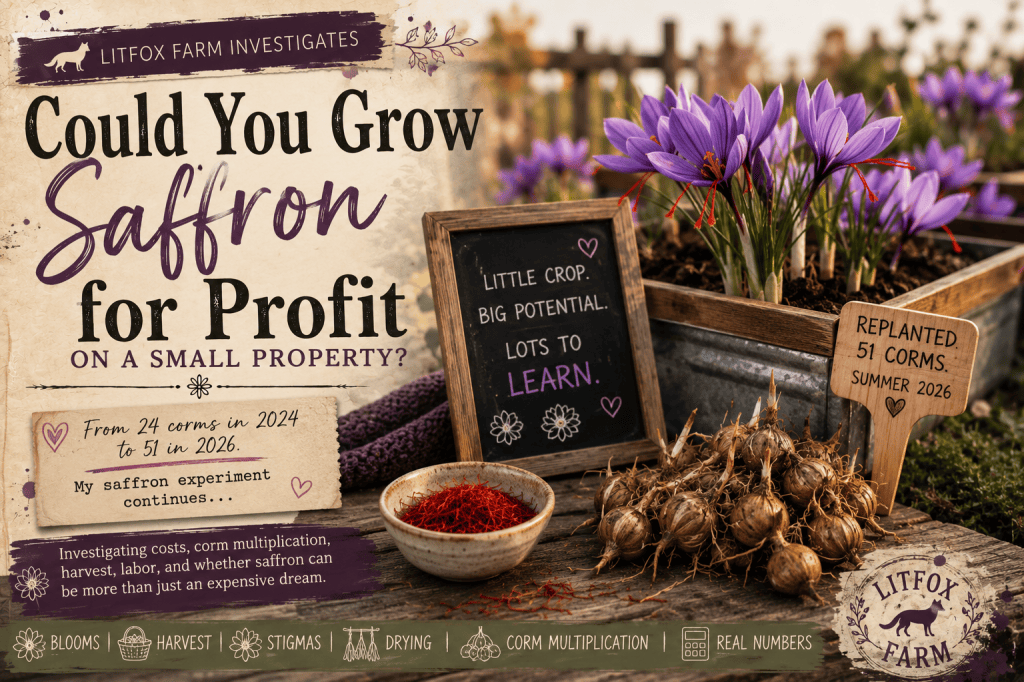
  • Growing Saffron for Profit on a Small Property?

    Growing Saffron for Profit on a Small Property?

    There are some garden projects you plan.

    And then there are the ones that secretly become an obsession.

    Saffron definitely falls into the second category.

    A few days ago, I replanted my saffron corms into a new waist-high raised bed.

    Not because the old bed wasn’t working.

    Because my back has officially started negotiating with me, and I figured if I’m hoping to grow this crop for years to come, I might as well make harvesting and dividing corms a little easier on Future Lindsay.

    As I spread the corms across the bed, I couldn’t help but smile.

    Back in 2024, I planted 24 tiny corms.

    This summer, when I lifted them, I counted 51.

    No, I didn’t suddenly become a commercial saffron grower.

    No, I’m not claiming that’s what everyone should expect.

    But seeing those extra corms sitting in the wheelbarrow made me stop and think.

    “Huh… maybe there’s something here.”

    Not a get-rich-quick scheme.

    Not the next big agricultural revolution.

    Just… something worth paying attention to.

    So naturally, I started asking myself the question I seem to ask about everything these days:

    Could saffron actually become a worthwhile crop for a tiny farmstead?


    The Internet Makes Saffron Sound Like a Lottery Ticket

    If you’ve ever searched for saffron online, you’ve probably seen the headline.

    “The World’s Most Expensive Spice.”

    It’s technically true.

    And it’s also one of those facts that’s just misleading enough to send people down the wrong path.

    The price sounds incredible because saffron is sold in tiny amounts.

    Nobody is buying a five-pound bag of saffron for Tuesday night’s pasta.

    You’re talking about delicate threads harvested by hand from thousands of flowers.

    High price doesn’t automatically mean high profit.

    That’s an important distinction.

    Because while saffron may sell for impressive prices by weight, the journey from flower to spice is surprisingly labor intensive.


    Three Little Threads

    Every saffron flower produces exactly three red stigmas.

    Those three tiny threads are the saffron.

    That’s it.

    No shortcuts.

    No machines.

    Every flower is picked by hand.

    Every stigma is removed by hand.

    Then everything has to be dried correctly.

    Suddenly the high price starts making a little more sense.

    When people say saffron is expensive…

    It’s because somebody earned it.


    The Part That Fascinated Me Wasn’t the Spice

    Honestly?

    It was the corms.

    When I first planted saffron in 2024, I wasn’t thinking much beyond…

    “Wouldn’t it be fun to grow my own saffron?”

    I certainly wasn’t sketching business plans.

    But when I lifted those original 24 corms and counted 51 healthy replacements…

    My brain shifted.

    Not toward spice.

    Toward multiplication.

    Because here’s the interesting thing about saffron.

    If conditions are right, healthy corms can multiply over time.

    Not overnight.

    Not magically.

    Not on a perfectly predictable schedule.

    But steadily enough that I started wondering…

    Could a small planting slowly become a larger one?

    Could today’s little experiment eventually become several beds?

    Could one nursery bed quietly support expansion for years?

    Now we’re speaking my language.


    My Goal Isn’t More Spice…

    It’s Better Systems

    One thing I learned this year?

    Growing saffron and harvesting saffron are two different skills.

    I successfully grew the corms.

    Harvesting every bloom at exactly the right moment…

    Let’s just say I have room to improve.

    So this year’s goal isn’t to maximize income.

    It’s to become a better saffron grower.

    The new waist-high bed should make harvesting, dividing, and maintaining the planting much easier.

    Sometimes the best investment isn’t buying more plants.

    It’s making it easier to care for the ones you already have.


    Then I Started Daydreaming

    This is where things usually get dangerous.

    Because once I started thinking about 51 corms…

    I started wondering what happens after that.

    Not next year.

    Five years from now.

    Ten years from now.

    Could one bed become two?

    Could a nursery bed eventually produce healthy corms for expansion?

    Would there ever be enough to share with other gardeners?

    Could I eventually sell corms?

    Or would every extra one simply go back into expanding the planting?

    I genuinely don’t know.

    And that’s exactly why I’m writing this investigation instead of a how-to guide.


    The Math Is More Complicated Than It Looks

    The internet loves simple equations.

    High-value spice.

    ×

    Lots of flowers.

    =

    Profit.

    Reality, as usual, refuses to cooperate.

    Corms don’t all multiply equally.

    Some flowers never bloom.

    Harvest timing matters.

    Drying matters.

    Storage matters.

    Labor definitely matters.

    And while it’s fun to calculate theoretical retail values…

    Those numbers don’t automatically become money in the bank.

    The difference between revenue and profit is where real businesses live.


    Then There’s the Question Nobody Talks About

    What if the spice isn’t the most interesting product?

    I’ve caught myself wondering whether the long-term opportunity for a tiny grower might actually be healthy corms.

    Please notice I said wondering.

    Not recommending.

    Not predicting.

    Just wondering.

    People who want to grow saffron need corms.

    Healthy, correctly identified corms.

    And if a grower spends years carefully expanding a healthy planting…

    Could that eventually become part of the business model?

    Maybe.

    But that’s a question for Future Lindsay.

    Present Lindsay is still figuring out how not to miss flowers during harvest.


    There Are Some Adult Conversations We Should Have

    Before anybody starts packaging saffron in cute little jars…

    Food products come with responsibilities.

    Depending on where you live, labeling requirements, food regulations, cottage food laws, and licensing may apply.

    The same goes for selling planting stock.

    Plant health matters.

    Quality matters.

    Local regulations matter.

    I’m intentionally taking the slow road here.

    I’d much rather learn the rules now than apologize for ignoring them later.


    Who Might Enjoy Growing Saffron?

    I think saffron could be a wonderful fit for someone who:

    • Enjoys unusual crops
    • Likes long-term projects
    • Has well-drained soil or raised beds
    • Doesn’t mind careful hand harvesting
    • Thinks in years instead of weeks
    • Gets excited about watching things slowly multiply

    Who Should Probably Skip It?

    Saffron probably isn’t your crop if:

    • You need quick cash flow.
    • You dislike repetitive hand work.
    • Your garden stays wet all winter.
    • You’re hoping one raised bed replaces your salary.
    • You lose interest when projects take several years to mature.

    Hidden Headaches

    A few stood out during my research—and now my own experience.

    • Startup corms can be expensive.
    • Harvest season is short.
    • Every flower is harvested by hand.
    • Timing matters.
    • Expansion takes patience.
    • The internet wildly oversimplifies saffron economics.

    Most importantly…

    The world’s most expensive spice still has to find a customer.


    The LitFox Scorecard

    Startup Cost: ⭐⭐⭐☆☆

    Small Property Friendly: ⭐⭐⭐⭐⭐

    Expansion Potential: ⭐⭐⭐⭐⭐

    Patience Required: ⭐⭐⭐⭐⭐

    Storage Simplicity: ⭐⭐⭐⭐☆

    Labor During Harvest: ⭐⭐⭐⭐☆

    Internet Hype Risk: ⭐⭐⭐⭐⭐

    My Curiosity Level: ⭐⭐⭐⭐⭐


    So… Could You Grow Saffron for Profit on a Small Property?

    Maybe.

    But I don’t think that’s the first question anymore.

    After watching 24 corms become 51, I think the better question is:

    Could you patiently build something meaningful over time?

    That’s a much more interesting experiment.

    This year, those 51 corms are settling into their new waist-high bed.

    My goal isn’t to make money from them.

    My goal is to become better at growing them.

    To pay closer attention.

    To improve my harvest.

    To learn what this little crop wants to teach me.

    Maybe five years from now, I’ll look back and laugh at how small this planting was.

    Or maybe I’ll decide saffron is happiest staying exactly what it is today—a fascinating little corner of the garden.

    Either outcome feels worthwhile.

    Because one of the biggest lessons LitFox Farm keeps teaching me is this:

    The best opportunities usually don’t arrive all at once.

    They quietly multiply underground while you’re busy learning how to care for them.

    And honestly…

    That feels like a pretty good metaphor for building a life, too.


    🌱 Want to Follow the Saffron Experiment?

    This saffron bed is still very much an experiment.

    Over the next few years, I’ll be documenting what happens… from bloom timing and harvest to corm multiplication, bed expansion, and whether saffron truly earns a permanent place in the LitFox Farm ecosystem.

    If enough readers are interested, I’ll combine the research, the real-world results, and everything I learn into a practical Saffron Quick-Start Guide for anyone who wants to run their own experiment.

    Interested? Join the Saffron Experiment and I’ll keep you posted.

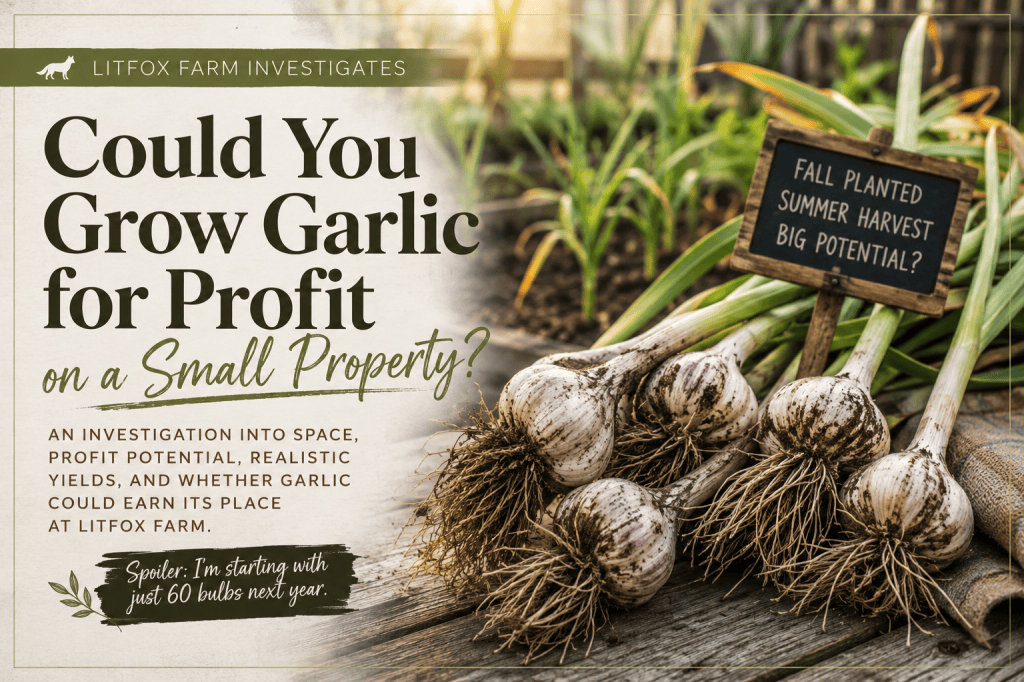
  • My Actual Garlic Experiment Is Much Smaller Than This

    My Actual Garlic Experiment Is Much Smaller Than This

    Here is probably the most important context for this entire investigation:

    I am not planting a garlic field.

    I am not even dedicating a whole giant bed to garlic.

    My current plan is much less dramatic.

    I’m lining the edges of some of my existing garden beds with garlic.

    That’s it.

    I’m looking at space that already exists, asking whether garlic can tuck into the edges without hijacking the rest of the garden, and hoping—if all goes reasonably well—to harvest somewhere around 60 bulbs next year.

    Sixty.

    Not six thousand.

    Not enough to become the Garlic Queen of Sussex County.

    Just sixty.

    And weirdly, I think that makes this experiment more interesting.

    Because one of the questions I keep coming back to with LitFox Farm is not:

    How much land do I need to start a farm business?

    It is:

    What can I do with the land and infrastructure I already have?

    I have beds.

    Those beds have edges.

    Could some of those edges grow garlic?

    Could 60 bulbs teach me something useful?

    I think they could.

    Because if I harvest roughly 60 bulbs next year, I will immediately have decisions to make.

    Some will be for our kitchen.

    Some may not be beautiful enough to sell.

    Some of the healthiest bulbs might make more sense going right back into the ground as next year’s planting stock.

    And maybe—just maybe—a few could become my first tiny test of whether anyone would actually pay for LitFox-grown garlic.

    That is not a garlic business.

    But it is the beginning of evidence.

    What Could 60 Bulbs Actually Tell Me?

    This is where my brain starts getting dangerous.

    Suppose I harvest 60 bulbs.

    Not all 60 are automatically inventory.

    Maybe some go into my kitchen.

    Maybe some are too small.

    Maybe some are damaged.

    Maybe I deliberately keep the best for replanting.

    So perhaps I end up with only:

    20 or 30 bulbs I could realistically test as a product.

    At $3 each, 20 bulbs would be:

    $60 gross.

    Thirty bulbs:

    $90 gross.

    That is obviously not life-changing money.

    It is barely “I went to Target unsupervised” money.

    But that is not really the point.

    The point is that a tiny planting could answer questions I currently cannot answer from Google:

    • Does garlic actually grow well in these beds?
    • How does it handle my specific little northern New Jersey microclimate?
    • Do the bed edges work, or does the rest of the planting interfere?
    • What percentage becomes genuinely beautiful?
    • How much labor does it feel like in real life?
    • Where will I cure 60 bulbs?
    • Do I enjoy growing it?
    • Does anyone I know actually want local garlic?
    • Would a future roadside-stand customer buy it?
    • Which varieties make me want to plant more?

    And maybe the biggest question:

    Does garlic earn the right to take up more space next year?

    That feels like a much better first-year goal than trying to reverse-engineer a five-figure garlic business before I have harvested a single bulb.

    Then I would tweak the ending too, so the post comes full circle:

    I do not know whether garlic will become an income crop at LitFox Farm.

    Right now, I’m just lining the edges of beds I already have and hoping to pull around 60 bulbs from the ground next year.

    That is a very small beginning.

    But maybe that is the point.

    If those 60 bulbs grow well, I can learn.

    If people are interested, I can test.

    If the test works, I can plant more.

    If it doesn’t, I still have garlic.

    Which, as failed business experiments go, is honestly a pretty decent outcome.

    I think I am becoming less interested in asking:

    “How do I build the whole thing right now?”

    And more interested in asking:

    “What is the smallest version I can try with what I already have?”

    For garlic, apparently, the answer is the edges of my garden beds and a hopeful little target of 60 bulbs.

    We’ll see what grows from there.

    🌱 Follow the Garlic Experiment

    This fall, I’ll be planting garlic around the edges of my garden beds here at LitFox Farm, with a hopeful goal of harvesting around 60 bulbs next year.

    I’ll be documenting everything—the wins, the mistakes, the numbers, and whether this little experiment actually has the potential to become a small income stream.

    If enough people are interested, I’ll compile everything I learn into a practical Garlic Quick-Start Guide for anyone who wants to try their own experiment.

    Interested? Join the Garlic Quick-Start Interest List and I’ll keep you posted.

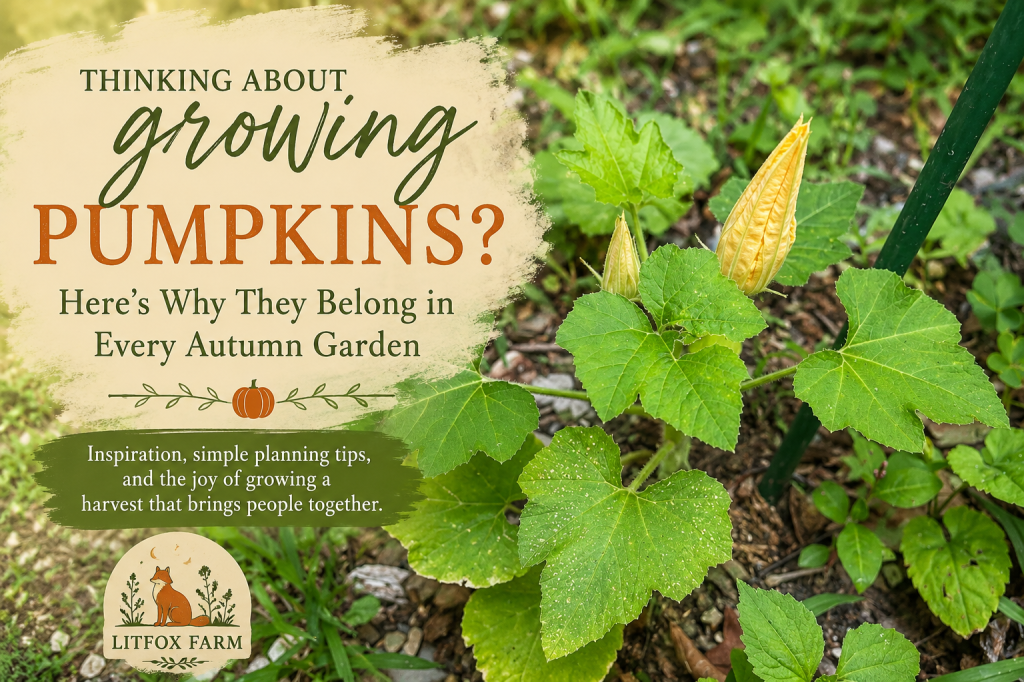
  • Thinking About Growing Pumpkins? Here’s Why They Belong in Every Autumn Garden

    Thinking About Growing Pumpkins? Here’s Why They Belong in Every Autumn Garden

    There comes a moment every summer when the garden begins to whisper that the seasons are changing.

    It doesn’t happen all at once. The calendar may still insist it’s summer, and the afternoons can still be hot enough to send you searching for shade. But if you spend enough time outside, you’ll notice the little signs.

    Tomatoes begin blushing red on the vine.

    Sunflowers stretch confidently toward the sky.

    The first goldenrod starts appearing along country roads.

    Even the mornings feel different. Just for a few minutes before the sun climbs higher, there’s the faintest hint of coolness in the air—a quiet reminder that autumn is already making its way toward us.

    And somewhere beneath a tangle of sprawling green vines, something magical is happening.

    Pumpkins are growing.

    They don’t announce themselves with bright blooms like zinnias or towering stalks like corn. Instead, they quietly swell beneath broad leaves, almost hidden until one day you lift a vine and realize there’s a pumpkin sitting there, patiently becoming exactly what it was meant to be.

    That’s one of the things I love most about pumpkins.

    They teach us to think months ahead.

    Long before porch decorations appear in stores, before apple cider fills mugs, before sweaters come out of storage, pumpkin growers have already been tending vines, watching blossoms open, welcoming bees, watering through dry spells, and trusting that nature knows what she’s doing.

    Growing pumpkins asks us to slow down.

    To prepare.

    To wait.

    To believe that today’s small efforts become tomorrow’s harvest.

    If you’ve ever dreamed about having your own pumpkin patch—even if it’s only a few vines tucked into the corner of your yard—mid-summer is actually the perfect time to start learning. Not because you’ll be planting tomorrow, but because watching the season unfold helps you understand what pumpkins need and how they fit into the rhythm of the year.

    This isn’t meant to be a complete growing guide. Think of it more like a conversation while we wander through the garden together, imagining what next year’s harvest could become.

    Why Pumpkins Are Such a Wonderful Beginner Crop

    Every gardener remembers growing something for the first time.

    Maybe it was a tomato plant on an apartment balcony.

    A handful of beans climbing a fence.

    A sunflower that somehow became taller than everyone expected.

    For many people, pumpkins become one of those unforgettable first adventures.

    Part of the reason is simply how approachable they are.

    Pumpkin seeds are easy to find. Every spring, garden centers, seed catalogs, and local hardware stores seem to carry at least a handful of varieties. You don’t have to search for rare seed suppliers or invest a fortune before getting started.

    They’re also surprisingly affordable.

    A single packet of seeds can grow several healthy plants, each capable of producing multiple pumpkins depending on the variety and growing conditions.

    That’s a pretty wonderful return on a small investment.

    Pumpkins also tend to be forgiving teachers.

    Will every vine produce perfect fruit? Probably not.

    Will insects visit?

    Will weather throw you a few surprises?

    Almost certainly.

    But that’s part of gardening.

    Pumpkins introduce beginners to these lessons in a way that feels exciting rather than discouraging.

    They’re also one of the few crops that seem to delight every generation.

    Children love watching tiny green pumpkins appear where flowers once bloomed.

    Adults find themselves checking the vines almost daily.

    Neighbors stop to ask how they’re growing.

    Before long, the pumpkin patch becomes something people naturally gather around.

    Perhaps most importantly, pumpkins teach patience.

    You cannot hurry a pumpkin.

    No amount of wishing will make it ready before its time.

    Instead, pumpkins invite us to embrace a slower rhythm—a lesson that’s becoming increasingly valuable in a world that often expects instant results.

    Growing pumpkins isn’t just about producing food or decorations.

    It’s about learning to notice the seasons.

    It’s about understanding that gardening isn’t measured only by what we harvest but also by the experiences we collect along the way.

    In many ways, pumpkins become less of a crop and more of an annual tradition.

    A Walk Through the Pumpkin Patch

    If you’ve never wandered through a pumpkin patch in late July, I hope you’ll make time to do it this year.

    Most people visit pumpkin farms in October.

    Few realize how alive they are in midsummer.

    The vines seem to have a mind of their own.

    They stretch across the ground, curling around themselves, weaving between grasses, and slowly claiming every bit of open space they can find.

    Their broad leaves create little islands of cool shade beneath the summer sun.

    Bright yellow blossoms seem to appear everywhere at once.

    Some bloom for only a short while before fading, having quietly completed their purpose.

    Listen closely and you’ll hear the steady hum of bees.

    They move from flower to flower with remarkable focus, carrying pollen that makes the next generation of pumpkins possible.

    Without them, there would be no harvest.

    Beneath those blossoms, tiny pumpkins begin to form.

    Some are no larger than a marble.

    Others already resemble miniature versions of the pumpkins they’ll eventually become.

    Each one represents possibility.

    Walking through a pumpkin patch reminds us that gardens are never still.

    Even when nothing seems to be happening, life is unfolding beneath the leaves.

    This fall, if you visit a local pumpkin farm, pause for a moment before heading straight to the biggest pumpkins.

    Look at the vines.

    Notice the leaves.

    Watch the bees.

    See if you can imagine what the field looked like just a few months earlier.

    There’s something deeply comforting about realizing every pumpkin began as a single blossom and a little patience.

    Choosing the Right Pumpkin

    One of the happiest surprises for new gardeners is discovering that “pumpkin” isn’t just one thing.

    There are dozens—really hundreds—of varieties, each with its own personality.

    Some are perfect for carving.

    Others shine in the kitchen.

    Some exist simply because they’re beautiful.

    Jack-o’-lantern pumpkins are probably the ones most people picture first. They’re the classic orange pumpkins that become smiling faces on front porches each October.

    Pie pumpkins are smaller and sweeter. While they may not look as dramatic, they’re prized for baking into pies, breads, soups, and other autumn favorites.

    White pumpkins bring a completely different feeling to the garden. Their creamy color pairs beautifully with fall flowers and natural decorations, creating a softer harvest display.

    Mini pumpkins might fit in the palm of your hand, but they’re packed with charm. Scatter them across a table, tuck them into window boxes, or let children decorate with them.

    Decorative gourds are wonderfully quirky. Twisted, striped, bumpy, colorful—each one seems to have its own personality.

    Then there are heirloom varieties.

    These pumpkins often carry fascinating histories and unique shapes, colors, and textures that remind us how diverse gardening can be. Some are blue-gray, some are deeply ribbed, and others seem almost too beautiful to harvest.

    Choosing a pumpkin variety isn’t just about size.

    It’s about imagining the traditions you’d like to create.

    Do you dream of homemade pie?

    Family carving nights?

    Autumn porch displays?

    A harvest table filled with every color imaginable?

    The pumpkins you grow can become part of those memories.

    Planning for Next Year

    One of the most enjoyable parts of gardening happens long before the first seed goes into the ground.

    It’s the dreaming.

    Winter and early spring often become seasons of planning.

    Where might the pumpkin patch go?

    How much sunshine does that corner of the yard receive?

    Will the vines have enough room to wander?

    Pumpkins appreciate generous space.

    They’re enthusiastic growers, and that’s part of their charm.

    Healthy soil is another gift we can prepare ahead of time.

    Good gardens rarely happen by accident.

    Over time, adding compost, encouraging healthy soil life, and caring for the land creates a stronger foundation for every crop that follows.

    Pollinators deserve a place in the plan as well.

    A garden buzzing with bees, butterflies, and other beneficial insects is a joyful sight, and pumpkins depend on many of those visitors.

    Thinking about water is equally worthwhile.

    Summer weather has a way of surprising us, and having a watering plan before it’s needed often makes gardening feel less stressful.

    Finally, there’s harvest.

    Not just harvesting pumpkins, but imagining what comes afterward.

    Where will they cure?

    How will they be displayed?

    Will neighbors receive one?

    Will seeds be saved?

    Planning ahead transforms gardening from a series of chores into something much more intentional.

    Each decision becomes part of a story that’s still unfolding.

    Harvest Season

    There comes a day when you realize the pumpkin has stopped growing.

    Instead of becoming larger, it begins becoming richer.

    Its color deepens.

    The rind hardens.

    The stem slowly changes, hinting that harvest isn’t far away.

    It’s one of my favorite transitions in the entire gardening year.

    Harvest isn’t simply about picking pumpkins.

    It’s about recognizing the season you’ve been working toward all along.

    Carefully cutting the pumpkin while leaving a portion of the stem attached helps prepare it for the weeks ahead.

    Many gardeners also allow pumpkins to cure for a short time, helping them store longer and develop even better color.

    Then comes the fun part.

    Pumpkins appear on porches beside pots of mums.

    They become centerpieces for autumn tables.

    Some head into the kitchen.

    Others become decorations that welcome friends and family throughout the season.

    Extra pumpkins often find their way to neighbors, coworkers, teachers, or relatives.

    There’s something wonderfully old-fashioned about sharing part of the harvest.

    Even after the pumpkins have been enjoyed, the season isn’t quite finished.

    Seeds can be cleaned and saved for future gardens.

    Others become roasted snacks.

    Eventually, the vines and leftover plant material return to the compost pile, beginning the cycle once again.

    Gardening has a beautiful way of reminding us that endings are often beginnings in disguise.

    More Than Just Halloween

    It’s easy to think of pumpkins as decorations.

    After all, that’s how many of us first experienced them.

    But pumpkins become much more meaningful once you’ve grown them yourself.

    A homemade pumpkin soup on a chilly evening somehow tastes even better when the pumpkin came from your own garden.

    Fresh pumpkin pie carries an entirely different story when you’ve watched that fruit grow from blossom to harvest.

    Roasted pumpkin seeds become a satisfying reminder that very little needs to go to waste.

    Even empty shells can become wildlife food, compost, or simply nourish next year’s garden.

    Pumpkins also create moments.

    Family photographs.

    Children proudly carrying tiny pumpkins they’ve grown themselves.

    Friends gathering for cider around a porch filled with autumn color.

    Visits to local farm stands.

    Community harvest festivals.

    These are the memories that tend to stay with us.

    For some families, pumpkin growing slowly grows into something larger.

    A roadside stand with extra pumpkins.

    Seasonal decorating bundles.

    A small patch that welcomes neighbors each fall.

    For others, one or two vines provide everything they need.

    Both paths are equally worthwhile.

    A meaningful harvest isn’t measured by acreage.

    It’s measured by the joy it brings.

    A Gentle Invitation

    Sometimes we convince ourselves that we need to know everything before we begin.

    We read every guide.

    Watch every video.

    Compare every variety.

    Meanwhile, another growing season quietly passes by.

    Gardens don’t ask us to know everything.

    They simply ask us to begin.

    Many beautiful homesteads started with one raised bed.

    One tomato plant.

    One herb tucked beside the back door.

    Or one little patch of pumpkins.

    Each season teaches something new.

    One year you’ll learn about pollinators.

    Another year you’ll discover the importance of healthy soil.

    Another season might simply remind you how peaceful it feels to spend an evening walking among the vines.

    There is no finish line.

    Only another season waiting to begin.

    If growing pumpkins has been sitting quietly on your someday list, perhaps this is the year to start imagining where those vines might grow next spring.

    Sometimes that’s all a dream needs—a little room to take root.

    In summary…

    Pumpkins have a remarkable way of reminding us that some of life’s best rewards cannot be hurried.

    They invite us to prepare long before anyone else is thinking about autumn.

    They ask us to care consistently through hot summer days, to trust unseen growth beneath broad green leaves, and to celebrate when the harvest finally arrives.

    Whether your dream is a front porch lined with homegrown pumpkins, a family tradition of carving pumpkins together each October, a roadside stand overflowing with autumn color, or a future pumpkin patch where neighborhood children make memories they’ll carry for years, every harvest begins the same way.

    With a single seed.

    Planted months before anyone else is thinking about fall.

    And perhaps that’s the real lesson pumpkins offer us.

    The life we hope to enjoy tomorrow is often shaped by the quiet things we’re willing to nurture today.


    Join the Waitlist: Growing Pumpkins for Pleasure & Profit

    If today’s walk through the pumpkin patch has you dreaming about next year’s garden, I’d love to invite you to join the waitlist for our upcoming guide, Growing Pumpkins for Pleasure & Profit.

    This future guide will take a deeper look at planning your first pumpkin patch—from choosing the right varieties and preparing healthy soil to seasonal care, harvesting, curing, and saving seeds for future seasons. We’ll also explore simple ways to share or sell extra pumpkins through farm stands or local markets, along with ideas for creating meaningful autumn traditions around your harvest.

    Whether your goal is to grow a few pumpkins for your family or simply learn more about this timeless crop, we’d love to have you along for the journey.

    Join the waitlist today, and you’ll be among the first to know when the guide is ready.

    Until then, enjoy the season you’re in—and keep dreaming about the one that’s still to come.